

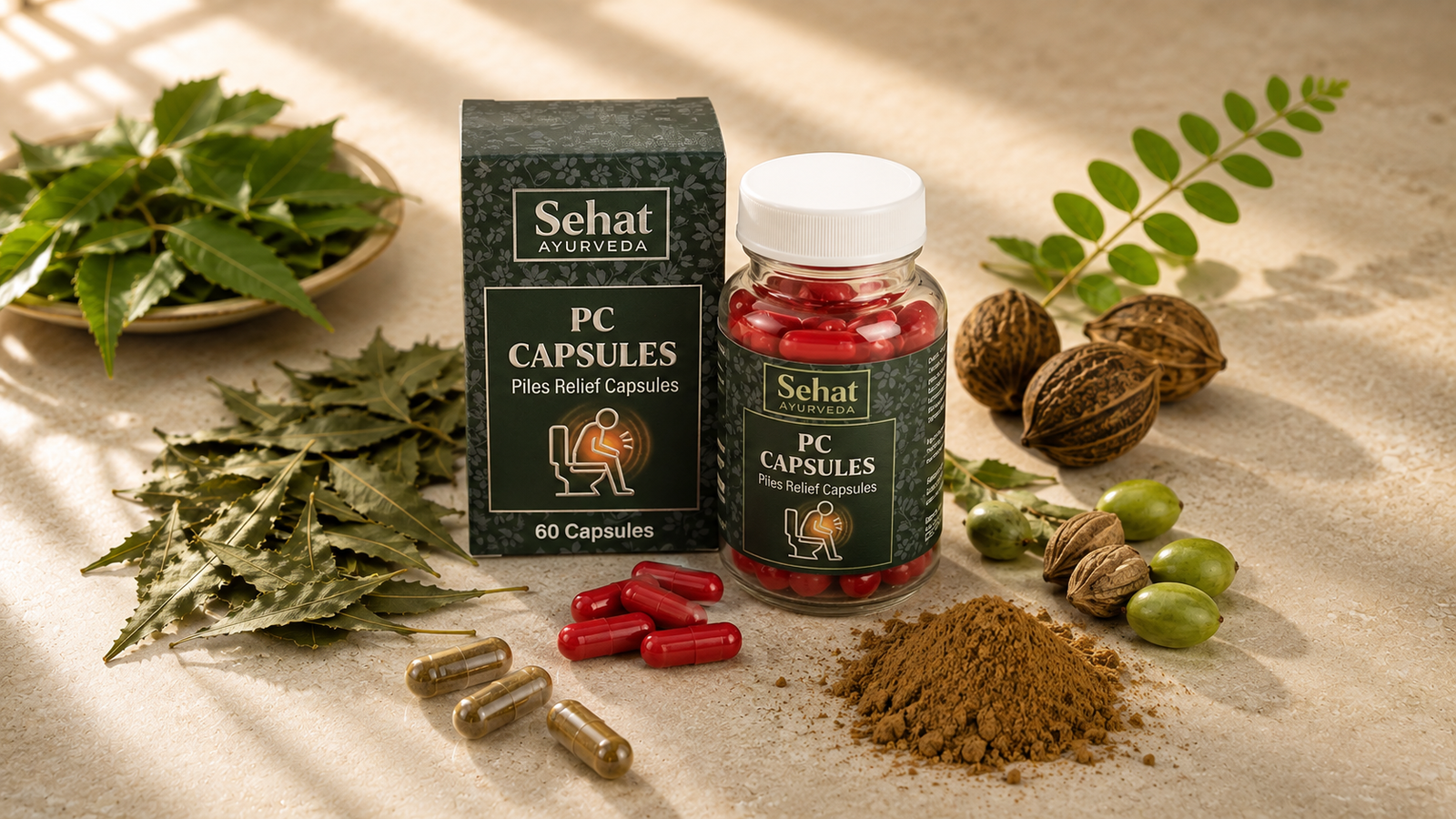
Herbal Piles Capsules: Ingredients, Uses & How They Support Digestive Health
Anyone searching for herbal piles capsules usually wants one thing before they buy:
to know what’s actually inside the bottle and why it should help. Fair question, especially with
dozens of ayurvedic piles capsule options crowding the shelf and most product pages
saying little beyond “100% natural.”This article breaks that pattern. Below, we walk through every ingredient in
Sehat Ayurveda’s PC Capsules, what each one is traditionally used for, how the
formulation connects piles relief to digestive health, and exactly how to use it — so you’re
deciding with information, not just marketing copy.
Traditional Ayurvedic uses referenced below reflect historical and classical use of these herbs;
individual results vary, and persistent or severe symptoms always warrant a doctor’s evaluation.
What Are Herbal Piles Capsules, Exactly?
Herbal piles capsules are oral Ayurvedic formulations — herbal extracts combined
into a capsule and taken internally rather than applied topically. That distinction matters:
creams and ointments address surface-level itching or discomfort, while capsules work through
digestion, targeting factors such as constipation and straining that can contribute to piles.
PC Capsules follow this internal-first approach, combining six selected herbal extracts rather
than relying on a single herb.
Inside PC Capsules: The Six Herbal Extracts
Each hard gelatin capsule contains the following ingredients by quantity:
| Ingredient | Traditional Role | Amount |
|---|---|---|
| Azadirachta indica (Neem) Seed Extract | Traditionally used for antimicrobial and anti-inflammatory support | 125 mg |
| Melia Azedarach (Bakain) Seed Extract | Traditionally used for anti-inflammatory support and digestive regularity | 125 mg |
| Clerodendrum Phlomidis (Arni) Extract | Traditionally associated with digestive fire (Agni), hemorrhoids and constipation | 40 mg |
| Terminalia Chebula (Haritaki) Extract | Classic Ayurvedic bowel regulator and one of the core herbs of Triphala | 215 mg |
| Holarrhena Antidysenterica (Kutaja) Extract | Traditionally classified as “Arshoghna” (anti-hemorrhoidal) and used for bleeding piles and gastrointestinal disorders | 215 mg |
| Berberis Extract | Traditionally associated with anti-inflammatory, antimicrobial and astringent properties | 215 mg |
Two ingredients are worth calling out specifically because they’re not the usual
Neem-and-Haritaki combination most competing capsules lean on.
Kutaja (Holarrhena antidysenterica) carries a direct classical association
with hemorrhoid-related use, appearing in Ayurvedic literature as a piles-focused herb rather
than solely a general digestive herb.
Arni (Clerodendrum phlomidis) plays a broader traditional role. It is one of
the ten roots associated with Dashamula and is also referenced traditionally for hemorrhoids
and constipation.
How These Herbal Piles Capsules Support Digestive Health
Piles and digestion aren’t completely separate concerns. Chronic constipation can lead to
repeated straining, while straining increases pressure in the veins around the rectum. This
pressure can contribute to the development or worsening of hemorrhoids.
That’s the logic behind combining Haritaki, Kutaja and Arni in one formulation.
Haritaki is traditionally used to support bowel regularity, while Kutaja is associated with
gastrointestinal health and Arni is traditionally used to support digestive function and
constipation.
Meanwhile, Neem, Melia Azedarach and Berberis are traditionally associated
with antimicrobial, astringent or anti-inflammatory properties. Together, these ingredients
are intended to provide traditional herbal support for both digestive and anorectal wellness.
What PC Capsules Are Traditionally Used For
Based on the formulation’s ingredients and their traditional Ayurvedic applications,
PC Capsules are traditionally used to support:
- Piles-related comfort — supporting comfort associated with hemorrhoids.
- Bleeding associated with piles — several ingredients have traditionally
been associated with astringent and Arshoghna properties. - Swelling and inflammation — Neem, Berberis and Melia Azedarach are
traditionally associated with anti-inflammatory support. - Anal fissure care — as part of a broader dietary and lifestyle approach.
- Healthy bowel movements — Haritaki and Arni are traditionally used
to support bowel regularity. - Overall anorectal health — as part of a consistent daily wellness routine.
These statements reflect traditional Ayurvedic uses of the ingredients involved.
Individual results vary. Rectal bleeding shouldn’t automatically be assumed to be piles;
persistent or unexplained bleeding needs medical evaluation.
Separately, published Ayurvedic clinical research has examined other herbal formulations
for bleeding piles. A
2011 clinical study published in the journal Ayu
looked at Triphala Guggulu in patients with bleeding piles. Because Triphala includes
Haritaki, the research provides useful background on how related Ayurvedic herb combinations
have been studied, although it does not evaluate this specific PC Capsules formulation.
How to Take Herbal Piles Capsules the Right Way
Consistency matters more than any single dose. The recommended usage is
1 capsule twice daily after meals with lukewarm water, or as directed by
a physician.
Do not exceed the advised intake, and don’t expect results from only a few days of use.
Herbal products can take time to show noticeable effects, and individual responses vary.
Alongside the capsules, three everyday habits can provide important supporting care:
- Drink enough water throughout the day.
- Maintain adequate dietary fiber intake.
- Avoid prolonged sitting and straining during bowel movements.
The capsules provide herbal support, while these lifestyle habits can help reduce constipation
and the pressure associated with straining.
Storage Instructions
Keep the capsules in a cool, dry and dark place, away from heat, direct light
and moisture. Keep them out of reach of children. Do not refrigerate.
Who Should (and Shouldn’t) Rely on Capsules Alone
Herbal capsules may be considered as part of conservative care for mild hemorrhoid symptoms,
particularly when constipation, diet and straining are contributing factors.
For a detailed comparison of conservative Ayurvedic care and surgical treatment, read our guide:
Ayurveda vs Surgery for Piles
.
However, capsules aren’t the right tool for every anorectal symptom. If bleeding is heavy or
persistent, if there is discharge or fever, or if a lump does not reduce, medical evaluation
is important rather than relying on capsules alone.
You can also learn more about the differences between common anorectal conditions in our guide:
Piles vs Fissure vs Fistula
.
Frequently Asked Questions
What ingredients are in herbal piles capsules?
PC Capsules contain six herbal extracts:
Neem, Melia Azedarach, Clerodendrum Phlomidis (Arni), Haritaki,
Kutaja and Berberis. These ingredients are traditionally associated
with digestive, bowel-regulating, antimicrobial, astringent and anti-inflammatory support.
How long do herbal piles capsules take to work?
Individual results vary. Some people may notice changes over several weeks of consistent
use alongside appropriate dietary and lifestyle habits. If symptoms don’t improve or
become worse, a clinical evaluation is recommended rather than continuing self-managed
treatment indefinitely.
Can herbal piles capsules stop bleeding piles?
Several ingredients in the formulation have traditional astringent and Arshoghna
(anti-hemorrhoidal) associations. However, persistent or heavy rectal bleeding should
always be evaluated by a doctor rather than automatically being attributed to piles.
Are herbal piles capsules safe for daily use?
PC Capsules are formulated from selected herbal extracts intended for regular use
as directed. Anyone taking other medication or managing an existing health condition
should consult a healthcare professional before starting a new herbal product.
Do herbal piles capsules help with digestion, not just piles?
The formulation includes ingredients such as Haritaki and Arni,
which have traditional uses related to bowel regularity and digestive support.
This is relevant because constipation and straining can contribute to hemorrhoid symptoms.
The Bottom Line
Herbal piles capsules work best when you understand what’s actually inside them and how
the ingredients are traditionally used. PC Capsules combine six herbal
extracts intended to provide traditional support for digestive health, bowel regularity
and anorectal comfort.
Paired with consistent use, adequate hydration and a fiber-forward diet, this approach can
form part of conservative care for people dealing with mild piles-related symptoms.
Persistent, severe or unexplained symptoms should always be evaluated by a qualified
healthcare professional.